8 Types of Solar Panels Explained: Which One Is Best for Your Solar Installation in 2026
Compare solar panel types in 2026! We explain Mono PERC, TOPCon, HJT, IBC, bifacial, half-cut & more by cell technology to help you make the best investment.

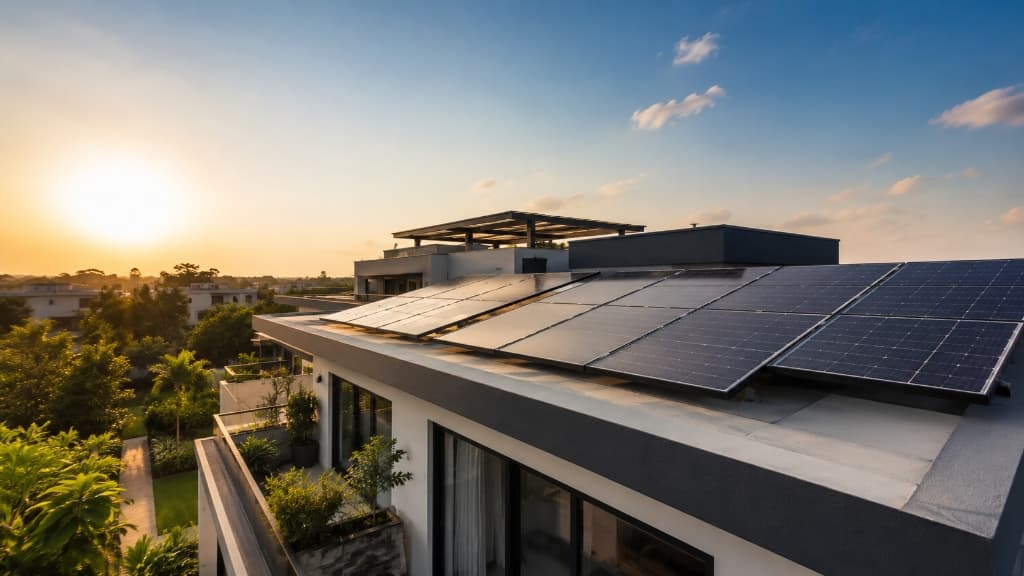
Going solar is one of the smartest financial decisions a homeowner or business owner can make in 2026. But once you start getting quotes, the jargon hits fast: Mono PERC, TOPCon, HJT, bifacial, thin-film, half-cut cells, glass-glass… It can feel like learning a foreign language.
The truth is, not all solar panels are created equal. The type of panel you choose directly affects how much electricity you generate, how long your system lasts, how it performs on hot days, and ultimately, how quickly you recover your investment.
This guide cuts through the noise. We explain every major solar panel type in plain English — what the technology actually does, who it's best suited for, and how it compares on the factors that matter most to you: efficiency, cost, and lifespan.
Internal Link → Not sure about installation costs first? See our detailed breakdown of solar installation costs before diving into panel types.
How Solar Panels Are Categorised: Two Different Classification Systems
When you hear "types of solar panels," it's worth knowing there are actually two separate ways the industry classifies panels — and both affect what you end up with on your roof.
1. By Cell Technology
This is what most guides (including the sections below) focus on. Cell technology refers to the material and engineering of the photovoltaic cell itself — the fundamental unit that converts sunlight into electricity. The major cell technologies covered in this guide are:
- Mono PERC — the residential workhorse
- Poly PERC — the budget option
- TOPCon — the rising premium standard
- HJT (Heterojunction) — the temperature champion
- IBC (Interdigitated Back Contact) — the efficiency record-holder
- Thin-Film (CdTe / CIGS) — lightweight and flexible
- Perovskite — the exciting future technology
Each of these technologies differs in how efficiently it converts sunlight, how it behaves in heat, and how long it lasts.
2. By Panel Structure / Format
Separately from cell technology, panels also differ in how they are physically assembled and structured. These structural or format choices include:
- Monofacial vs. Bifacial — does the panel generate power from one face or both?
- Half-cut cell vs. Full-cell — are the silicon cells cut in half before wiring? (Half-cut cells reduce resistive losses and shade sensitivity.)
- Shingled cells — cells overlapped like roof shingles, eliminating busbars for a higher packing density.
- Multi-busbar (MBB) — multiple thin wires (instead of 3–5 thick busbars) to collect current more efficiently and reduce cracking risk.
- Glass-glass vs. Glass-backsheet — is the rear of the panel sealed with a second glass sheet (more durable, better for bifacial) or a traditional polymer backsheet?
Here is the critical thing to understand: panel structure and cell technology are independent choices that combine freely. A TOPCon panel, for example, can be monofacial or bifacial, half-cut or full-cell, glass-glass or glass-backsheet. An HJT panel is nearly always glass-glass by design, but it can be half-cut or shingled. The cell technology tells you about the semiconductor physics; the structure tells you about the physical build quality and installation profile.
Practical tip for comparing quotes: When you receive installer proposals, ask about both the cell technology and the panel format/structure. Two panels both labelled "TOPCon" can differ significantly in real-world durability and energy yield depending on whether one is half-cut glass-glass MBB and the other is a full-cell glass-backsheet design. A well-informed buyer asks for both specs — not just the technology name.
The Quick Answer: Solar Panel Comparison Table
Before we go deep, here's your at-a-glance reference. All figures reflect commercially available panels as of 2026.
| Panel Type | Efficiency Range | Approx. Cost/Watt | Typical Lifespan | Best Use Case | Temperature Coefficient |
|---|---|---|---|---|---|
| Mono PERC | 20% – 22% | ₹25 – ₹32 | 25–30 years | Residential (subsidy-eligible) | –0.35%/°C |
| Poly PERC | 17% – 19% | ₹20 – ₹26 | 20–25 years | Budget installs, rural setups | –0.40%/°C |
| TOPCon | 22% – 24% | ₹30 – ₹40 | 25–30 years | Space-constrained roofs, C&I | –0.30%/°C |
| HJT (Heterojunction) | 23% – 25%+ | ₹45 – ₹65 | 30+ years | Premium C&I, hot climates | –0.24%/°C |
| IBC | 24% – 26%+ | ₹60 – ₹90 | 30+ years | High-budget premium installs | ~–0.29%/°C |
| Bifacial | 20% – 25%+ (effective) | ₹32 – ₹55 | 25–30 years | Ground-mount, flat roofs | –0.30%/°C |
| Thin-Film (CdTe / CIGS) | 14% – 20% | ₹15 – ₹22 | 15–25 years | Large commercial, utility | –0.20%/°C |
| Perovskite (emerging) | 27%+ (lab, single-junction) | Not yet commercial | TBD | Future residential/C&I | Under research |
Note: Temperature coefficient tells you how much efficiency a panel loses per degree Celsius above 25°C. A lower (less negative) number means the panel handles Indian summer heat better.
Cost disclaimer: The ₹/Wp figures above are module-only, approximate market rates (mid-2026, ex-GST) — not installed-system costs. Your installer's per-watt quote will include inverter, mounting hardware, wiring, labour, and GST on top of this. Always compare quotes on a like-for-like basis.
1. Mono PERC Solar Panels — The Residential Workhorse
What is a Mono PERC solar panel?
Mono PERC stands for Monocrystalline Passivated Emitter and Rear Cell. It is the most widely installed rooftop solar panel technology in India today, and for good reason.
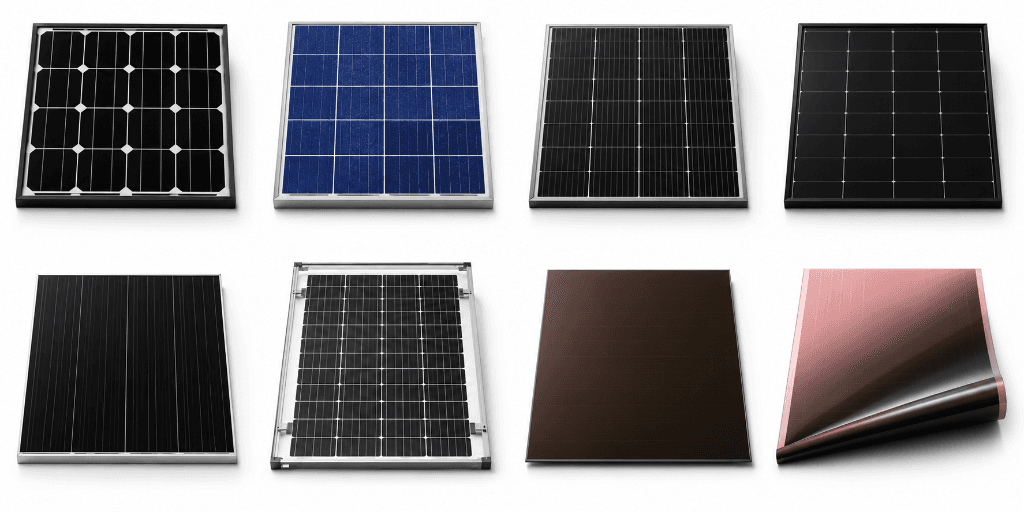
A monocrystalline cell is cut from a single, pure silicon crystal — giving it the uniform dark-black appearance you've likely seen on most modern rooftop systems. The "PERC" innovation adds a special reflective passivation layer to the back of each cell. Think of it like a mirror: sunlight that passes through the cell without being absorbed gets reflected back for a second pass, squeezing extra electricity out of the same panel.
Efficiency: 20% – 22% | Cost: Moderate | Subsidy-eligible (DCR): Yes
Who should choose Mono PERC?
Mono PERC is the right choice for the vast majority of homeowners in 2026. If you are applying for the PM Surya Ghar Muft Bijli Yojana, you must use DCR-certified panels — and Mono PERC in DCR format is the most readily available and cost-effective option to qualify.
Internal Link → Learn exactly how government subsidies work and what you qualify for on our Solar Subsidy Guide.
2. Poly PERC Solar Panels — The Budget Option
What is a Polycrystalline solar panel?
Polycrystalline (or Poly PERC) panels are made by melting multiple silicon fragments together, rather than using a single crystal. This makes them cheaper to manufacture but slightly less efficient, since the mixed crystal structure creates more "boundaries" where electrons get blocked.
The tell-tale sign: a speckled blue appearance, versus the solid black of mono panels.
Efficiency: 17% – 19% | Cost: Low | Subsidy-eligible (DCR): Generally not eligible for PM Surya Ghar subsidy — verify against MNRE's current ALMM list before purchase
Who should choose Poly PERC?
As of 2026, polycrystalline panels are largely a legacy technology in the Indian market. According to Mercom India's State of Solar PV Manufacturing in India 2026 report (based on December 2025 capacity data), polycrystalline modules account for approximately 2% of India's total installed module manufacturing capacity — down from a dominant position just five years ago, as the industry has migrated decisively to TOPCon and Mono PERC.
In practical terms, this means:
- Finding a Tier-1 bankable manufacturer that is actively producing poly modules at scale in 2026 is genuinely difficult. Supply exists through B2B marketplaces and secondary distributors, but with limited Tier-1 backing, long-term warranty support is uncertain.
- Subsidy eligibility is effectively closed: Most poly modules do not appear on MNRE's current ALMM List-I and will not qualify for the PM Surya Ghar Muft Bijli Yojana subsidy.
- The cost advantage has narrowed: Mono PERC prices have fallen sharply; the per-watt gap that once made poly attractive for large rural installs is smaller than it was and does not compensate for the sourcing and warranty risks.
Our recommendation: For buyers who previously would have chosen poly for a large rural or agricultural installation, Mono PERC is now the better default — it is widely available from Tier-1 manufacturers, subsidy-eligible, and available at prices close to what poly cost two years ago. If a specific, currently-active Tier-1 poly source can be verified, the technology is not defective — but that verification is now the buyer's burden, not the starting assumption.
See our DCR vs Non-DCR guide for subsidy eligibility details.
3. TOPCon Solar Panels — The Rising Premium Standard
What is a TOPCon solar panel?
TOPCon stands for Tunnel Oxide Passivated Contact. If Mono PERC is the reliable sedan, TOPCon is the luxury sedan — more efficient, longer lasting, and increasingly accessible in price.
TOPCon builds on the PERC architecture by adding an ultrathin tunnel-oxide layer and a layer of doped polysilicon to the rear of the cell. This dramatically reduces electron recombination — a process where electrons generated by sunlight get lost as wasted heat before they can become usable electricity. The result is meaningfully higher power output from the same roof area.
Efficiency: 22% – 24% | Cost: Premium | Temperature Coefficient: –0.30%/°C
Who should choose TOPCon?
TOPCon is ideal if:
- Your roof area is limited (city apartments, terraced houses) and you need to generate maximum kilowatt-hours from a constrained space.
- You're installing a commercial rooftop system (50kW+) and want superior 25-year yield projections.
- You want future-proof technology — TOPCon is fast becoming the new standard, with DCR variants now entering the market.
Internal Link → See how different panel types affect system sizing and output on our Solar Installation page.
4. HJT (Heterojunction Technology) Solar Panels — The Temperature Champion
What is an HJT solar panel?
HJT, or Heterojunction Technology, is a genuinely clever hybrid design. It sandwiches a crystalline silicon layer between two ultra-thin layers of amorphous (non-crystalline) silicon. By combining two different silicon types, HJT captures a broader spectrum of sunlight and dramatically reduces heat-related energy loss.
Here's why that matters in India: conventional panels lose efficiency as temperatures climb. On a scorching 45°C summer day in Rajasthan or Maharashtra, a standard Mono PERC panel might lose 7–8% of its rated output. An HJT panel loses less than 5% — generating noticeably more power precisely when your air conditioner is running hardest.
Efficiency: 23% – 25%+ | Temperature Coefficient: –0.24%/°C (best-in-class among crystalline technologies)
Who should choose HJT?
HJT is best suited for:
- Commercial & Industrial (C&I) projects where maximising annual energy generation justifies the higher upfront cost.
- Installations in hot climate zones (Rajasthan, Gujarat, Maharashtra, Telangana) where summer heat degrades conventional panels.
- Premium residential buyers who want the highest long-term ROI and plan to keep the system for 30+ years.
5. IBC (Interdigitated Back Contact) Solar Panels — The Efficiency Record-Holder
What is an IBC solar panel?
IBC stands for Interdigitated Back Contact. In a conventional solar cell, metal contact fingers sit on the front surface and block some incoming sunlight — a small but measurable loss. IBC panels move all electrical contacts to the rear of the cell, leaving the entire front surface available to absorb light.
The result: IBC panels hold the highest commercial efficiency of any mainstream silicon technology. LONGi's Hybrid IBC (HIBC) technology reached a certified cell efficiency of 28.13% (ISFH, April 2026), with commercial HIBC modules (EcoLife series) at 25% mass-production efficiency — the highest commercialised module efficiency of any silicon-based technology as of mid-2026. Aiko Solar's ABC (All Back Contact) modules represent another active IBC platform reaching commercial module efficiencies above 24%.
Efficiency: 24% – 26%+ (commercial modules); cell records exceeding 28% (LONGi HIBC, April 2026) | Cost: Very high | Lifespan: 30+ years with extremely low degradation
Who should choose IBC?
IBC panels are a niche, high-budget choice — typically reserved for:
- Premium residential installations where aesthetics and maximum output per square metre are both priorities.
- Specialized applications like solar-powered boats, vehicles, or off-grid cabins where space is severely constrained.
- Buyers for whom only the absolute best will do and budget is not the primary concern.
One important caveat for hot-climate installations: IBC panels typically carry a temperature coefficient of around –0.29%/°C, which is inferior to HJT's –0.24%/°C. In high-temperature Indian climates — where solar cell operating temperatures can exceed 55°C in summer — this gap produces a measurable difference in annual energy yield. If heat performance is your primary driver alongside maximum efficiency, HJT is generally the better choice even at the premium end.
For most homeowners in India, the cost premium of IBC over TOPCon or HJT does not justify the marginal efficiency gain. But if you're building a luxury property and want the best solar system money can buy, IBC is it.
6. Bifacial Solar Panels — Harvesting Light from Both Sides
What is a bifacial solar panel?
Bifacial panels generate electricity from both the front and the rear face of the panel. The rear side captures reflected (albedo) sunlight bouncing off the ground, rooftop surface, or surrounding environment. Depending on the surface reflectivity below the panels, bifacial systems can generate 10% – 30% more energy than equivalent monofacial panels.
Most bifacial panels use TOPCon or HJT cell technology internally — so they combine the benefits of those technologies with the bonus rear-side generation.
Effective Efficiency: Up to 25%+ (bifacial gain dependent on installation) | Best Installations: Ground-mount arrays, flat concrete rooftops, elevated carport structures
Who should choose bifacial panels?
Bifacial panels deliver their promised gains only when installed correctly — specifically, elevated off the surface with a reflective ground below (white-painted concrete, gravel, or open ground). They underperform in standard flush-rooftop residential installs where the rear panel face is blocked.
Best use cases:
- Ground-mounted solar farms
- Solar carports and canopy structures
- Flat commercial rooftops where panels can be mounted on elevated racking
- Agricultural solar (agrivoltaic) systems
Internal Link → Considering a commercial installation? Explore our Solar Installation services to see how bifacial systems can maximise your ROI.
7. Thin-Film Solar Panels (CdTe & CIGS) — Lightweight and Flexible
What is a thin-film solar panel?
Thin-film panels are made by depositing one or more layers of photovoltaic material — typically Cadmium Telluride (CdTe) or Copper Indium Gallium Selenide (CIGS) — onto a glass, plastic, or metal substrate. This manufacturing process is fundamentally different from the crystalline silicon used in all the technologies above.
The result is a panel that is:
- Thinner and lighter than crystalline silicon panels
- Flexible (in CIGS form) — can conform to curved surfaces
- 14%–20% efficient in commercial form — modern CdTe modules (e.g., First Solar Series 7) reach 18%–20%, while older CIGS and amorphous-silicon products sit at the lower end of this range — with excellent low-light and diffuse-light performance
- Best-in-class temperature coefficient (–0.20%/°C for CdTe)
The largest solar installation in the world (many utility-scale farms in the USA) use CdTe thin-film panels from First Solar — a testament to their viability at scale.
Who should choose thin-film panels?
In the Indian residential and small commercial context, thin-film panels are rarely the right choice due to their lower efficiency demanding significantly more roof space for the same output. However, they are compelling for:
- Large utility-scale solar farms (1 MW+) with abundant land
- Building-integrated photovoltaics (BIPV) — flexible CIGS panels embedded in roofing materials, facades, or skylights
- Speciality applications like curved architectural surfaces
8. Perovskite Solar Panels — The Exciting Future Technology
What is a perovskite solar panel?
Perovskite solar cells are the most talked-about emerging technology in the solar industry. Rather than silicon, they use a class of crystalline materials with a specific structure (called the perovskite structure) as the light-absorbing layer. In laboratory conditions, the highest rigorously benchmarked single-junction perovskite efficiencies now exceed 27%. The most widely cited NREL-chart figure is 27.3% (early 2026); separately, SolaEon Technology announced an NPVM-certified result of 27.87% in January 2026, achieved on a 0.076 cm² micro-scale device — a meaningful distinction, since small-area lab cells routinely outperform the larger-area devices that appear in standard efficiency charts. Both figures confirm the technology has clearly crossed the 27% threshold; the exact ceiling remains a moving target. On the tandem front, perovskite-silicon cells have surpassed 35%: LONGi announced an ESTI-certified record of 35.5% on July 14, 2026.
Why hasn't everyone switched to perovskite? Because the technology still faces significant challenges:
- Durability: Perovskite cells degrade faster than silicon when exposed to moisture and UV light.
- Lead content: Most high-efficiency perovskite formulations contain lead, raising environmental concerns.
- Scalability: Moving from laboratory cells to commercial-scale panels is still being solved.
Who should choose perovskite in 2026?
No one — yet. Perovskite panels are not commercially available for residential or standard commercial purchase in 2026. Early utility-scale pilot shipments of perovskite-silicon tandem modules have begun from a small number of manufacturers, but these projects lack the long-term field data and residential-grade warranties required for household adoption. Industry analysts broadly project that homeowner-ready perovskite panels — with the 20–25-year warranties required for residential trust — are unlikely to arrive before 2027–2030, with most timelines clustering around 2028–2029. This is a forecast, not a guarantee; the technology is moving fast and the window could compress or slip.
How to Choose the Right Solar Panel for Your Home or Business
Still not sure which panel is right for your situation? Use this simplified decision framework:
Are you a homeowner applying for PM Surya Ghar subsidy?
→ Choose DCR Mono PERC. It qualifies for the subsidy, delivers excellent efficiency, and gives you the fastest payback period.
Do you have limited roof space but high energy consumption?
→ Upgrade to TOPCon. Higher watts per square metre means you generate more power from the same footprint, even if you pay a small premium per watt.
Are you in a very hot climate (Gujarat, Rajasthan, Telangana) or installing a large commercial system?
→ Consider HJT. Its industry-leading temperature coefficient means it produces more electricity on your hottest, highest-consumption days.
Are you installing ground-mount or a flat commercial rooftop?
→ Evaluate bifacial panels. The rear-side generation bonus can significantly boost your system's annual output.
Are you a large industrial or utility buyer?
→ Consult with our experts. A mix of TOPCon bifacial or HJT bifacial is often the optimal choice for large-scale C&I projects.
Not sure what applies to your specific roof and energy profile? Request a free site assessment from Ensolvar's engineers — we'll analyse your consumption, roof orientation, shading, and local climate to recommend the exact panel technology that maximises your return on investment.
Frequently Asked Questions About Solar Panel Types
As of 2026, IBC (Interdigitated Back Contact) panels hold the highest commercial efficiency at 24%–26%+. For the best balance of high efficiency and cost-effectiveness, TOPCon and HJT panels are the top choices. Mono PERC remains the best value for standard residential installations.
For most Indian homeowners in 2026, DCR Mono PERC panels offer the best combination of efficiency, subsidy eligibility, and value. If your roof space is limited or you want a premium long-term system, TOPCon is an excellent upgrade. Both are available from Ensolvar.
Most quality crystalline silicon solar panels (Mono PERC, TOPCon, HJT) carry a 25-year performance warranty, guaranteeing at least 80% of original rated power at the end of that period. HJT and IBC panels often perform better than this warranty floor, with some manufacturers now offering 30-year warranties.
Monocrystalline panels are made from a single silicon crystal, giving them higher efficiency (20%+) and a uniform black appearance. Polycrystalline panels use multiple silicon fragments, are slightly less efficient (17%–19%), have a speckled blue look, and cost a bit less. For most Indian rooftops, monocrystalline Mono PERC is the preferred choice.
Yes — if installed correctly. Bifacial panels can generate 10%–30% more energy than equivalent monofacial panels, but only when the rear face is exposed to reflected light (i.e., elevated off the ground or roof surface). For standard flush-roof residential installs, the bifacial bonus is minimal. They are most valuable on ground-mount, carport, and flat commercial rooftop systems.
Yes. All solar panels lose some efficiency as temperatures rise above 25°C. The temperature coefficient tells you how much — a panel with –0.35%/°C loses 0.35% of its rated power for every degree above 25°C. On a 45°C roof, that's a 7% loss. HJT panels have the best temperature coefficient (around –0.24%/°C) among mainstream technologies, making them the top performer in India's hot summers.
TOPCon is more efficient and future-proof, but Mono PERC offers better value for most residential buyers. TOPCon panels (22%–24%) outperform Mono PERC (20%–22%) in efficiency, low-light performance, and long-term degradation rate. However, Mono PERC is more affordable and widely available in DCR format for subsidy eligibility. The right choice depends on your roof size, budget, and whether you need subsidy benefits.
These are structural or format choices — separate from, and combinable with, any cell technology. Monofacial vs. bifacial refers to whether a panel generates power from one side or both sides (bifacial needs elevated mounting to be worthwhile). Half-cut vs. full-cell refers to whether the silicon cells are sliced in two before wiring: half-cut cells reduce resistive power losses and make panels more tolerant of partial shading, without changing the cell's underlying technology. Always ask your installer for the full panel spec, not just the technology name.
Ensolvar installs Mono PERC, TOPCon, and HJT panels from MNRE-empanelled manufacturers — all sourced to meet DCR requirements where subsidy eligibility is needed. Our engineering team assesses your specific site conditions and recommends the panel technology that delivers the best return on investment for your home or business. Talk to our experts today.
The Bottom Line: Which Solar Panel Should You Choose in 2026?
The "best" solar panel is the one best matched to your specific situation — your roof size, your energy consumption, your climate zone, and your budget.
Here's the short version:
- Most homeowners: Mono PERC (DCR) — reliable, subsidy-eligible, excellent ROI
- Space-constrained roofs: TOPCon — more watts from less space
- Hot climates / premium buyers: HJT — best heat performance and lowest degradation
- Ground-mount / commercial: Bifacial TOPCon or HJT — maximise annual yield
- Future watchers: Perovskite — not yet, but exciting what's coming
The solar industry is evolving rapidly. What sets apart a great solar installation isn't just the panel type — it's proper system design, quality components, and expert installation that stands behind its work for the long haul.
Ready to go solar? Get a free, no-obligation solar consultation from Ensolvar. Our certified engineers will visit your site, analyse your roof and electricity bills, and present you with a fully customised solar proposal — including the exact panel type that will give you the best return on your investment. No pressure, no jargon, just honest solar advice.
Want to go deeper on specific topics?
- 📖 DCR vs Non-DCR Solar Panels: What's the Difference? — Understand how panel classification affects your subsidy eligibility.